



The expedition on R/V G.Yu. Vereshchagin on August 9-20, 2025 to study the deep-water fauna of Lake Baikal
On August 9-20, 2025, the expedition to study of the deep-water fauna of Lake Baikal was carried out on R/V G.Yu. Vereshchagin. The main aim of the expedition was to study the deep-water fauna of Lake Baikal, to use new methods in a study of the taxonomic diversity, speciation and ecological well-being of deep-sea fish of Lake Baikal.
Field works were carried out within the State Assignments №0279-2021-0005 “Study of transformations of the state of reservoirs and watercourses of Eastern Siberia in seasonal and long-term aspects under climate change, geological environment and anthropogenic loads” (led by A.P. Fedotov) and № 0279-2021-0010 “Genetics of communities of Baikal organisms: gene pool structure, conservation strategies” (led by D. Yu. Shcherbakov).
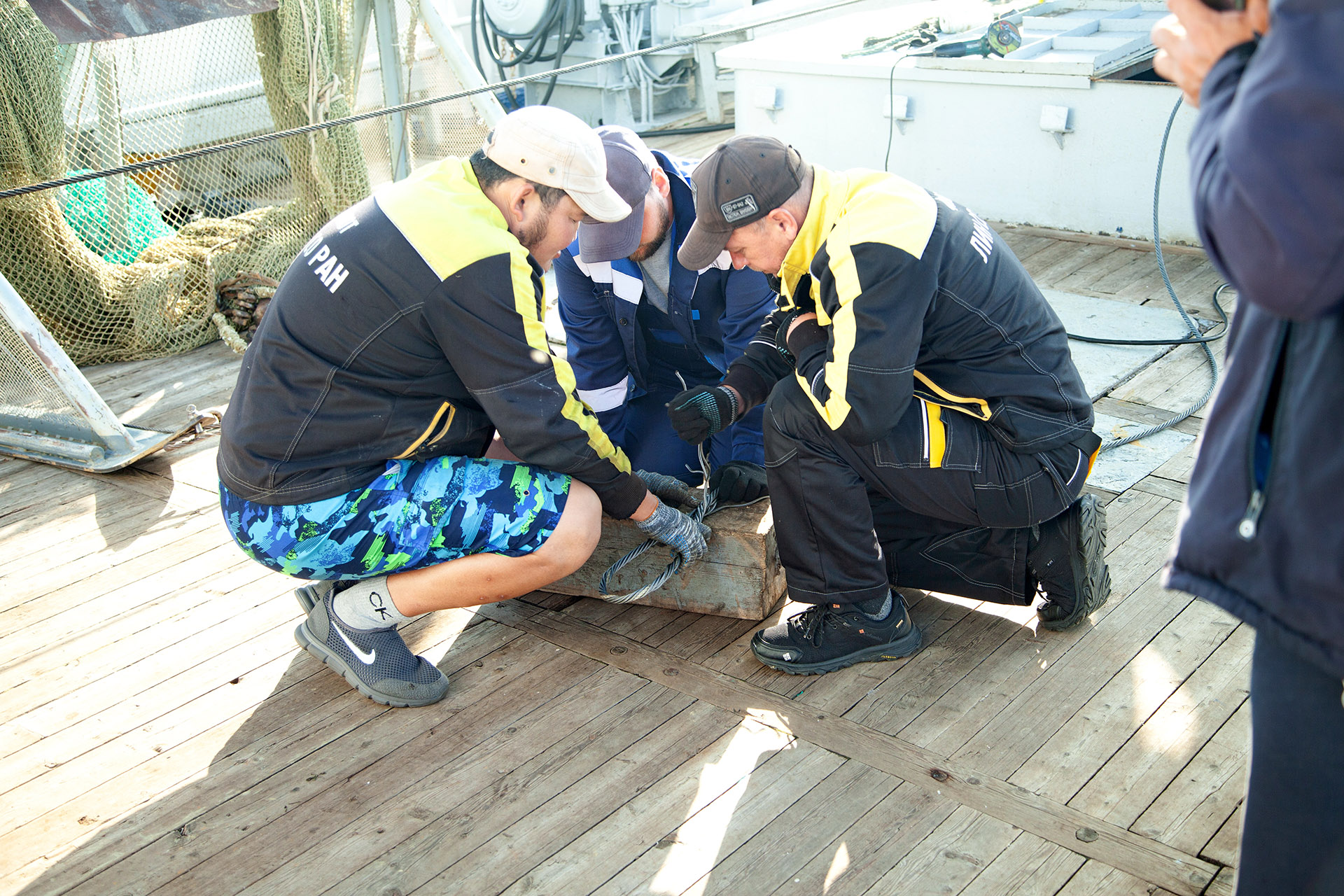
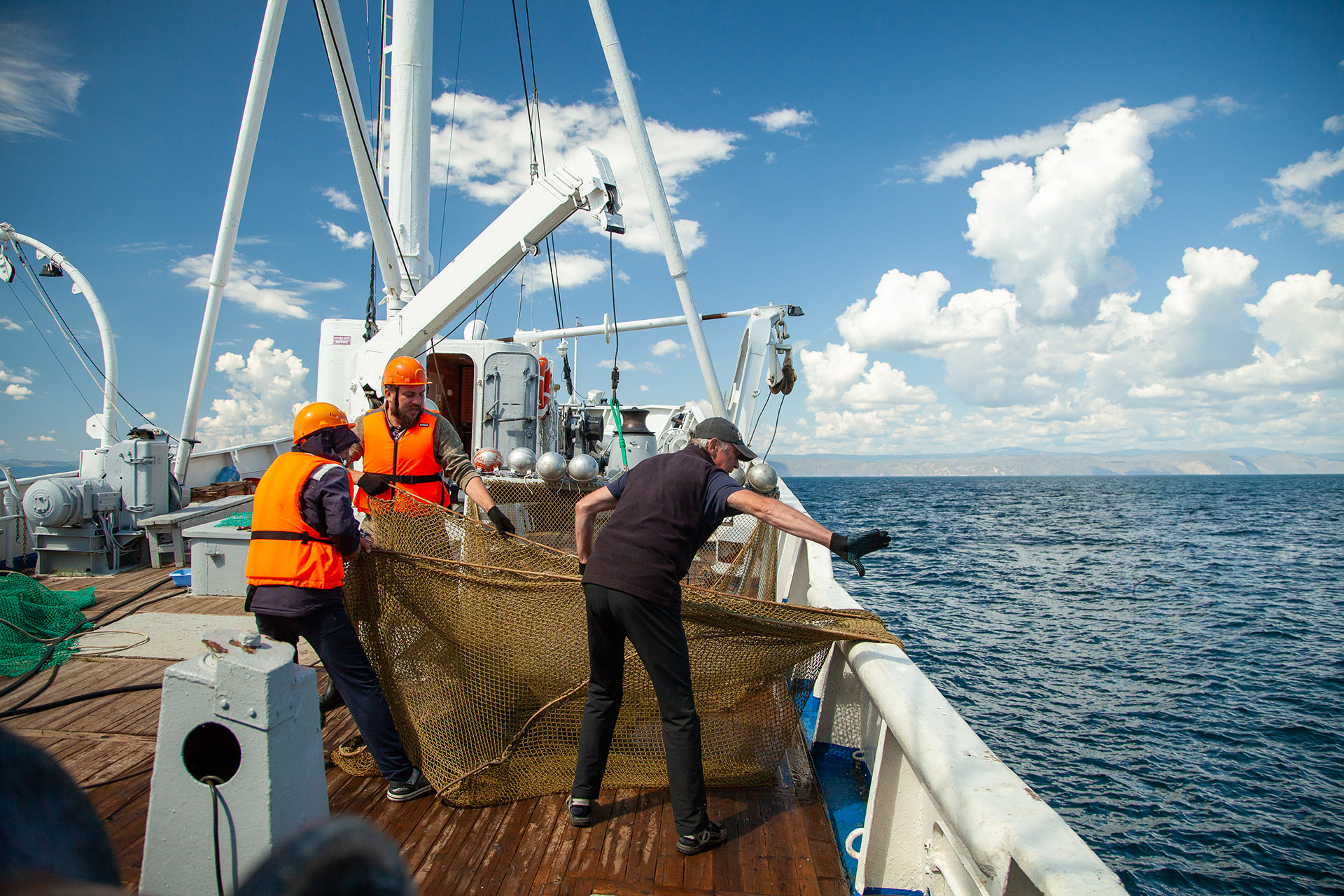
During the field work, 14 productive deep-sea trawls were carried out, a representative volume of material (samples) was collected for abyssal and pelagic species of cottids inhabiting various parts and basins of Lake Baikal. The maximum trawling depth was 1397 m. In the areas of the Maloye More Strait (Cape Ulan-Khan, Cape Verkhnie Khomuty and Bolshiye Koty settlement, diving material was collected for coastal fish species for experiments on board the R/V.
The objective of this study was to examine how bottom cottids adapt to living at depths exceeding 500 m (up to 1600 m) in relation to deep-sea pelagic and bottom coastal species. Additionally, the study aimed to evaluate the effectiveness of various biomarkers, including the morphological and functional traits of sensory systems, cytometric blood parameters, differential gene expression linked to adaptive responses, telomeric length, and telomerase activity.
For the control samples, the response rates of the specified parameters will be further determined, considering tissue specificity (blood, brain, sensory epithelium, liver, muscles, gill tissue, kidneys, intestines). Additionally, a search and identification of viruses affecting various species of cottids (Cottoidei) will be conducted for native samples. The viral communities present in Lake Baikal will be evaluated regarding their natural reservoir.
In the field, experiments were conducted to assess the impact of different stress factors (such as temperature and salinity) on model species of cottids. This research aims to advance the development of stress biomarkers and establish a non-invasive technique for analyzing RNA and DNA from the environment, in addition to evaluating the level of DNA methylation. Experiments were conducted to examine the effects of salinity and temperature on the blood parameters of coastal species (Leocottus kesslerii, Paracottus knerii) and the deep-water eurybathic species Asprocottus platycephalus.
In total, about 5,000 samples of various tissues were recorded for different types of analysis. The following species of Baikal Cottoidei were recorded:
Leocottus kesslerii (Sandy sculpin) - 9 pieces;
Paracottus knerii (Stone sculpin) - 17 pieces;
Batrachocottus nikolskii (Fatty sculpin) - 6 pieces;
Batrachocottus multiradiatus (Spotty-fins sculpin) - 6 pieces;
Batrachocottus baicalensis (Big-headed sculpin) - 5 pieces;
Cottocomephorus grewingkii (Yellowfin Baikal sculpin) - 10 pieces;
Cottocomephorus inermis (Longfin Baikal sculpin) - 10 pieces;
Comephorus baicalensis (Big Baikal oilfish) - 10 pieces;
Comephorus dybowski (Little Baikal oilfish) - 10 pieces;
Asprocottus platycephalus (Abyssal sculpin) - 10 pieces;
Asprocottus herzensteini (Шершавая широколобка) - 10 шту(Herzenstein`s rough sculpin) - 10 pieces;
Asprocottus intermedius (Rough sculpin) - 6 pieces;
Limnocottus pallidus (Narrow sculpin) - 10 pieces;
Limnocottus bergianus (Abyssal sculpin) - 8 pieces;
Limnocottus griseus (Dark sculpin) - 8 pieces;
Cyphocottus eurystomus (Broad-winged sculpin) - 6 pieces;
Cottinella boulengeri (Short-headed sculpin) - 10 pieces;
Abyssocottus korotneffi (Small-eyed sculpin) - 8 pieces;
Abyssocottus gibbosus (White sculpin) - 10 pieces;
Neocottus werestschagini (Deepwater sculpin) - 10 pieces;
Neocottus thermalis (Warm-water sculpin) - 11 pieces;
Procottus major (Big sculpin) - 6 pieces.
Erythrocyte lysates were prepared for hemoglobin structure studies, blood smears - to study morphology and cytometric parameters of blood cells, imprints of hematopoietic organs (spleen and kidneys) - to assess the immune status of fish, preparations of blood cells and hematopoietic tissues stained with fluorescent dye mitotracker to identify active mitochondria and assess the energy capabilities of the fish organism.
During the expedition, amphipod samples were taken from 13 trawl catches in the Northern, Middle, and Southern basins of the lake from depths of 225 to 1397 m. Over 30 species of the families Acanthogammaridae, Eulimnogammaridae, Crypturopodidae, Pachyschesidae, Pallaseidae were sampled. Also diving collection was carried out at depths of 1.5-3 m, several species of amphipods found in littoral were sampled (Eulimnogammarus, Pallasea, Eucarinogammarus).
The collected samples were fixed in a 70% alcohol solution, as well as in a solution of CTAB buffer for DNA extraction. Following this, DNA will be extracted in the laboratory, and the samples will be identified to the species level. The resulting high molecular weight DNA preparations will be suitable for various types of molecular analysis, in particular PCR, routine Sanger sequencing (determination of the nucleotide sequence), as well as high-throughput sequencing on the Illumina platform, etc.
The expedition members would like to thank the crew of the R/V G.Yu. Vereshchagin for the well-coordinated work and assistance in conducting deep-water trawls, and special thanks to the cooks for delicious and varied meals.









Vesti Irkutsk report: Read more...